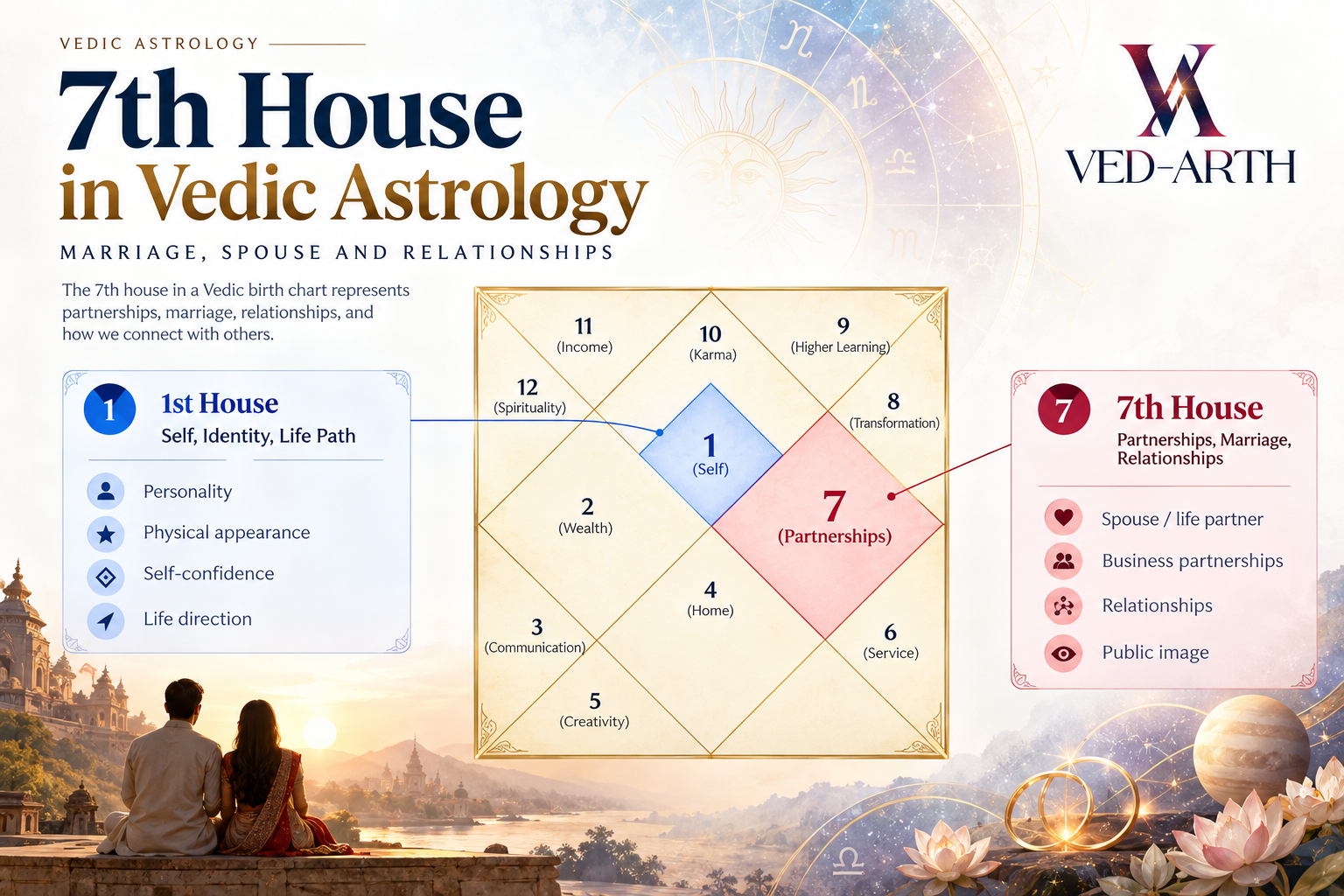
In Vedic astrology, the 7th house is the part of a birth chart traditionally associated with marriage, a spouse and sustained one-to-one partnerships. An astrologer reads its sign, ruling planet, occupants and aspects, then considers the Navamsa chart and timing periods. An empty 7th house or one challenging placement does not, by itself, predict whether someone will marry or how a relationship will turn out.
Key takeaways
· The 7th house concerns committed relationships and partnerships, including marriage.
· The 7th lord rules the sign in the 7th house and matters even when that house is empty.
· Planets in the 7th house offer interpretive themes, not guaranteed traits of a future spouse.
· Navamsa, or the D9 chart, adds another layer to traditional marriage analysis.
· Dasha and transit periods are considered for timing only after the chart is assessed.
· No placement replaces knowing a partner’s values, behaviour and willingness to build a relationship.
Someone looking at a Kundli often asks a very personal question: What does this say about my marriage? The 7th house is a sensible place to begin, but stopping there can turn a nuanced reading into an alarming one-line prediction. Jyotish is a traditional interpretive system. The meanings below explain how practitioners commonly approach a chart; they are not scientifically established methods for determining a person’s future.
What does the 7th house mean in Vedic astrology?
The 7th house in Vedic astrology represents significant one-to-one partnership. Marriage and a spouse are its best-known subjects, but its scope also includes committed relationships and business partnerships. It sits opposite the Lagna, or ascendant, the starting point from which houses are counted in a birth chart. The 1st house begins with the chart owner; the 7th turns attention toward another person and the relationship formed with them. It is sometimes called Kalatra Bhava, a traditional term associated with the spouse. This does not mean every detail of marriage can be read from this house alone.
What does the 7th house represent beyond marriage?
| Area | What a practitioner may examine |
| Marriage and spouse | Experience and expectations of committed partnership |
| Long-term relationships | Patterns that arise with sustained commitment |
| Business partnership | Formal collaboration with another person |
| Agreements and contracts | Give-and-take in mutual arrangements |
| Public interaction | Direct dealings with clients or collaborators |
These meanings are related, but they should not be collapsed into one prediction. A prominent partnership factor does not identify whether the relevant person is a spouse, associate or client without context.
How is the 7th house analysed in a birth chart?
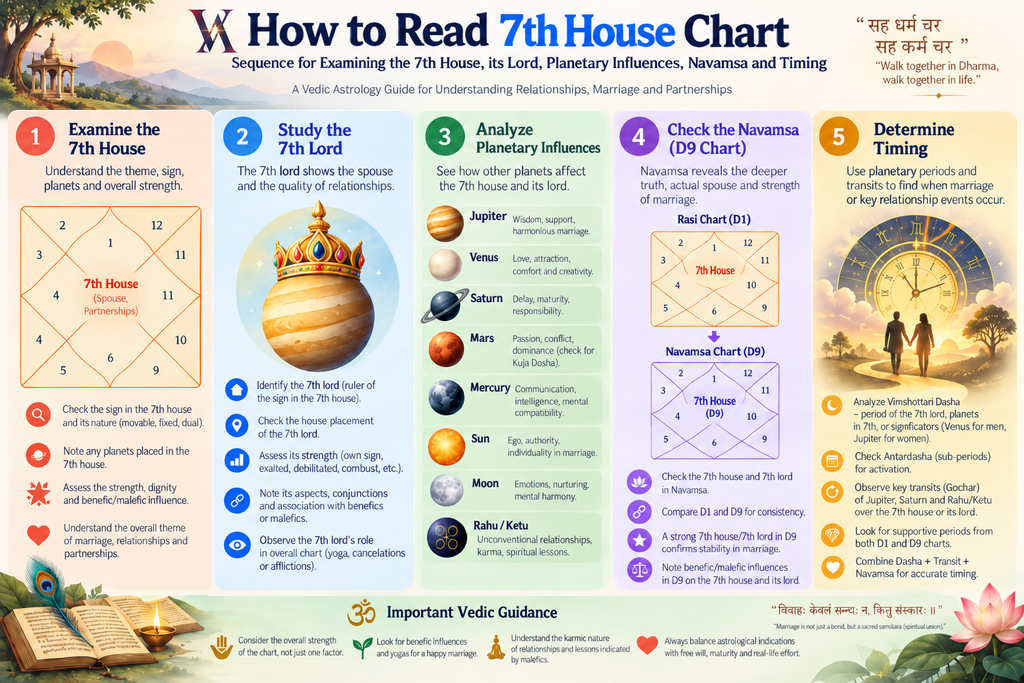
| Step | Question |
| 1. Lagna and 7th-house sign | Which sign occupies the 7th, and which planet rules it? |
| 2. The 7th lord | Where is that planet placed, and what does it connect? |
| 3. Occupants and aspects | Which planets occupy or influence the house? |
| 4. Strength and context | How are those planets placed by sign and house? |
| 5. Navamsa D9 | Does the divisional chart support or complicate the reading? |
| 6. Dasha and transits | When might relationship themes become prominent? |
The 7th lord is the planet ruling the sign found in the 7th house, even if the house contains no planet. For example, in a sign-based reading, Aries Lagna puts Libra in the 7th house, making Venus its lord. That tells the astrologer which planet to investigate next; it establishes no marriage outcome. Practitioners differ in the methods and weights they apply. A useful consultation makes its reasoning understandable rather than presenting a conclusion as inevitable.
Which planet signifies marriage?
There is no single planet that answers every marriage question. Venus is widely considered when discussing attraction, affection and relationship experience. Jupiter also appears in traditional marriage analysis, sometimes with different emphasis depending on the practitioner’s conventions. Neither replaces the 7th house and 7th lord. The Moon, divisional charts and active dasha periods may also add context. A claim such as “strong Venus guarantees a happy marriage” skips too much of the chart and too much of real life.
What do planets in the 7th house suggest?
A planet occupying the 7th house makes its themes more visible in a traditional reading. The following are starting points, not descriptions of a guaranteed spouse or outcome.
Sun in the 7th house
Identity, recognition and the balance between individual aims and shared decisions. The sign, lordship, aspects, strength and wider chart can change the interpretation.
Moon in the 7th house
Emotional responsiveness and the need for connection. The sign, lordship, aspects, strength and wider chart can change the interpretation.
Mars in the 7th house
Initiative, directness and conflict management; not proof of an unhappy marriage. The sign, lordship, aspects, strength and wider chart can change the interpretation.
Mercury in the 7th house
Conversation, negotiation and shared thinking. The sign, lordship, aspects, strength and wider chart can change the interpretation.
Jupiter in the 7th house
Values, counsel, learning or growth. The sign, lordship, aspects, strength and wider chart can change the interpretation.
Venus in the 7th house
Affection, attraction and the desire for companionship. The sign, lordship, aspects, strength and wider chart can change the interpretation.
Saturn in the 7th house
Commitment, responsibility, boundaries or patience; not automatic delay. The sign, lordship, aspects, strength and wider chart can change the interpretation.
Rahu in the 7th house
An intensified interest in partnership or unfamiliar experiences, according to some practitioners. The sign, lordship, aspects, strength and wider chart can change the interpretation.
Ketu in the 7th house
Questions of distance, independence or expectations of attachment in some interpretations. The sign, lordship, aspects, strength and wider chart can change the interpretation.
What if the 7th house is empty?
An empty 7th house means no planet occupies it in the chart being examined. It does not mean marriage is absent from a person’s life. The house still has a sign and a ruling planet. It may receive aspects, and its lord may connect with other important factors. Navamsa and timing periods add further context. If an app labels your 7th house “empty,” treat that as a description of occupancy, not a verdict on your relationships.
What if the 7th lord is weak?
A practitioner calling the 7th lord weak is making a judgement within a particular method. Ask what they mean: its sign, placement, aspects, conjunctions and supporting factors. A difficult-looking lord does not translate directly into no marriage, divorce or a particular type of spouse. Other chart factors may modify the reading, and people make choices within circumstances that a birth chart cannot describe. A severe conclusion should come with an explanation of both supporting and contrary indicators.
Does Saturn in the 7th house delay marriage?
Saturn in the 7th house does not, by itself, establish a marriage delay. In traditional interpretations Saturn can be associated with patience, duty and sustained effort. Some practitioners consider delay one possible expression, but that requires checking Saturn’s condition, the 7th lord, Navamsa and timing periods. The word “delay” also assumes marriage ought to happen by a certain age. Personal priorities, opportunity and choice remain relevant.
Does Mars in the 7th house always create Manglik Dosha?
No. Mars in the 7th is one placement considered in some Manglik or Mangal Dosha methods. Identifying and interpreting a dosha requires more than spotting Mars in one house. Practitioners may use different reference points and qualifying rules. They also assess the complete chart and, when the question concerns two people, both charts. An automated label should begin a careful explanation, not become a reason to reject a relationship.
What role does Navamsa D9 play in marriage analysis?
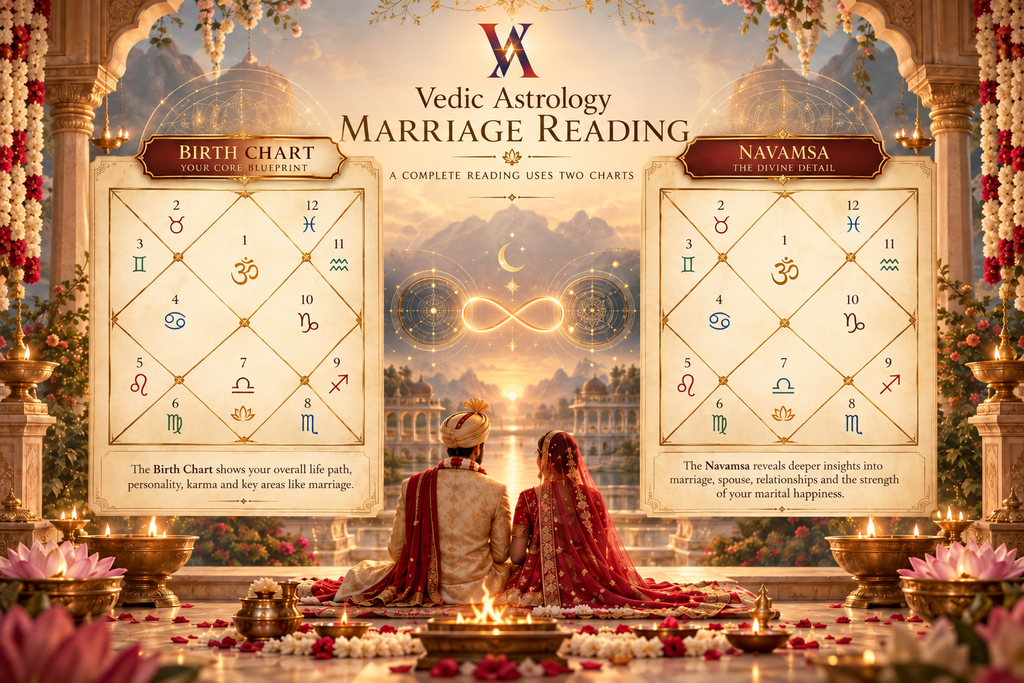
Navamsa, commonly called the D9 chart, is a divisional chart used in Jyotish. Marriage-focused readings often consider it beside the main birth chart, sometimes called D1 or the Rashi chart. The purpose is comparison, not replacement. If the readings differ, that calls for interpretation; it is not a licence to pick the more dramatic claim. D9 also depends on accurate birth details. Tell the astrologer if your birth time is uncertain before accepting a highly specific interpretation.
How is marriage timing assessed?
A 7th-house placement is not a calendar. In traditional timing analysis, a practitioner may first identify relevant factors in D1 and D9, then consider Vimshottari Dasha, a system of major and sub-periods, and Gochar, or transits. They look for several relevant factors converging within a period. Even then, a window is an interpretation, not a guaranteed wedding date. Marriage requires another person, mutual decisions and practical circumstances.
Can the 7th house predict your spouse or their appearance?
The 7th house may be used to discuss possible partnership themes in a traditional reading. It cannot reliably identify a particular future person, supply a photograph-like description or prove their character. Even careful symbolic descriptions need clear limits. For someone already in a relationship, direct experience of a partner’s actions and values is far more useful than fitting them into a planetary stereotype.
Common myths about the 7th house
- An empty house means I will never marry: Occupancy alone cannot answer that.
- A beneficial planet guarantees a happy marriage: No placement accounts for compatibility and behaviour.
- Saturn proves marriage will be late: Timing requires a broader assessment.
- Mars proves a relationship should end: A dosha label requires careful explanation and does not override the people involved.
- The 7th house identifies my exact spouse: It supports symbolic interpretation, not an assured identity or appearance.
Why does the whole Kundli matter?
The 7th house gives the reading its subject: partnership. The rest of the chart gives that subject context. The lord may connect relationship questions with another area of life; occupants and aspects may modify the emphasis; D9 may prompt closer inspection; and dasha analysis may raise a timing question. Imagine a hypothetical chart with no planet in the 7th, but with its lord receiving several influences elsewhere. Stopping at “empty 7th house” would overlook the planet ruling it. The next step is to study those connections and compare D9. This remains a structured discussion of traditional symbolism, not a test of someone’s worthiness of love.
Frequently asked questions
Is the 7th house only about marriage?
No. It is most often discussed for marriage and a spouse, but it also concerns significant one-to-one relationships, some business partnerships and agreements. The practitioner uses the question and wider chart to decide which meaning is relevant. A planet there does not make every partnership a marriage prediction.
Which matters more, the 7th house or 7th lord?
They answer different parts of one question. The house shows the area and its occupants or aspects. Its lord carries that subject into another part of the chart through its placement and condition. A thoughtful reading checks both.
Can you marry with no planets in the 7th house?
Yes. Empty means only that no planet occupies that house. Its sign, lord, aspects, Navamsa and timing factors can still be examined. It does not remove marriage or committed partnership from someone’s possible life choices.
Is Venus or Jupiter the planet of marriage?
Venus is commonly considered for relationship themes, while Jupiter is also used in some traditional approaches. Practices vary, including how older gender-based conventions are applied. Neither should be treated as the sole answer; the 7th house, lord and wider chart matter.
Can the 7th house reveal an exact marriage date?
No. A house placement alone cannot provide a date. Traditional timing may compare birth-chart factors, D9, planetary periods and transits. Any resulting window is an interpretation rather than a certainty; choices and circumstances also matter.
Does a difficult 7th house mean an unhappy marriage?
No single difficult indicator decides a marriage’s quality. Ask how the 7th lord, aspects, relevant planets and D9 modify the judgement. A favourable placement guarantees nothing either. Mutual respect, safety, communication and conduct are matters to assess in real life.
Is Kundli matching the same as reading the 7th house?
No. A 7th-house reading concerns one person’s chart. Kundli matching compares two charts using an explained compatibility method and may include other factors. Neither exercise replaces getting to know the other person or making an independent decision.
The 7th house helps organise partnership questions, but its most useful reading explains how a conclusion was reached. If a placement worries you, begin with the 7th lord and whole Kundli before accepting a verdict from an app or video. For a personal reading, see Ved-Arth’s marriage consultation. A consultation should explain its method and limits while leaving important decisions with you.