A birth chart contains many details, but one traditional classification often attracts special curiosity: paya in astrology. Known as Janma Paya, it assigns a symbolic metal to a person’s birth circumstances. Families may encounter it in a newborn’s Janam Patrika or during a Kundli consultation. Understanding its meaning requires more than calling one metal lucky and another unlucky. Different regional traditions use different calculations, and Paya never replaces a complete horoscope interpretation.
What Does Paya Mean in Vedic Astrology?
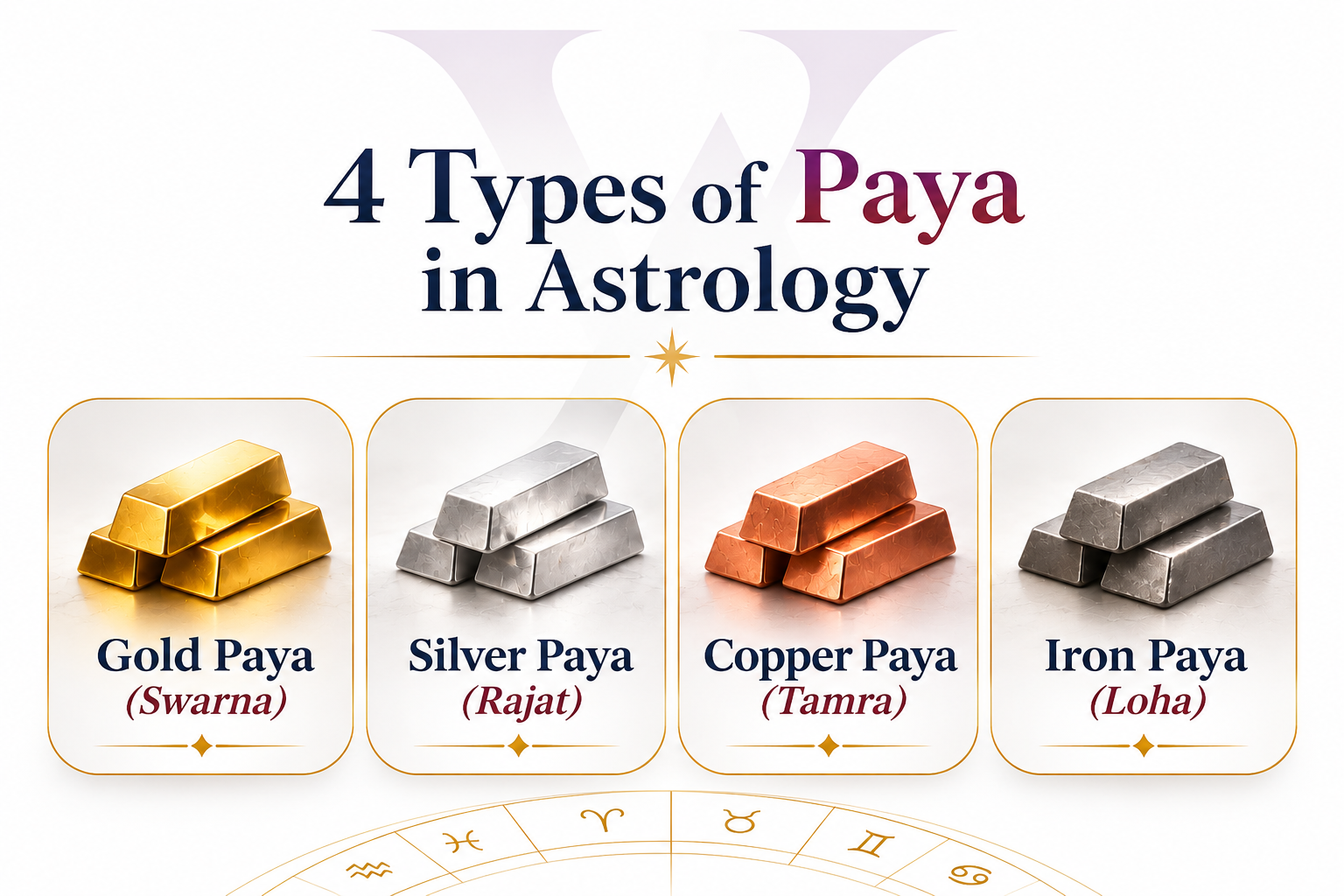
The Hindi word Paya means foot or foundation. In this context, it refers to a customary classification represented by gold, silver, copper, or iron. Astrologers sometimes interpret these metals as symbols of opportunities, responsibilities, stability, and effort.
Paya is especially familiar in North Indian horoscope traditions. However, it is not a scientifically validated predictor of prosperity, illness, marriage, or personality. Treat the symbolism as cultural and interpretive, not as a verdict about someone’s future.
Types of Paya in astrology
Four categories appear commonly in birth charts. Their interpretations are not identical across schools, so the following comparison describes frequently reported associations rather than guaranteed outcomes.
| Paya | Sanskrit name | Traditional association | Potential positive interpretation |
|---|---|---|---|
| Gold | स्वर्ण | Visibility, ambition, responsibility | Confidence and initiative |
| Silver | रजत | Comfort, support, harmony | Cooperation and steadiness |
| Copper | ताम्र | Action, adaptation, mixed experiences | Persistence and practical growth |
| Iron | लोह | Discipline, delays, obligations | Endurance and resilience |
Gold Paya: Ambition and Responsibility
Gold suggests prominence and high expectations in some interpretations. Other traditions regard it as demanding rather than automatically fortunate. Its practical significance depends on the Moon, Ascendant, planetary periods, and relevant house strengths.
Silver Paya: Stability and Support
The paya silver meaning in astrology is often associated with comfort, family support, and gradual progress. Some traditional Nakshatra reports specifically rank silver as the most favourable classification. Nevertheless, having a silver Paya does not guarantee financial security or effortless relationships.
Copper Paya: Effort and Adaptability
Understanding paya copper meaning in astrology can provide insight into its traditional symbolism. Copper represents mixed conditions in many popular readings. Challenges may be framed as opportunities to develop judgment and perseverance. However, astrological symbolism should not discourage someone from pursuing education, work, or relationships.
Iron Paya: Discipline and Resilience
Iron is sometimes labelled difficult because it is linked with responsibility and delay. Iron paya in astrology means facing challenges that may require patience, discipline, and consistent effort. However, this interpretation should never become a frightening prediction, particularly for a child. It can also symbolise strength, structure, resilience, and sustained effort.
How Is Paya Calculated?
Two methods are commonly encountered when using a paya astrology calculator. Before interpreting any result, identify which convention your astrologer or software follows, as different conventions can produce different metals for the same birth chart.
Method One: Moon’s House From Lagna
In the widely printed house method, determine the Ascendant, also called Lagna, and count the Moon’s house from it. The Ascendant is counted as house one. Then match the number against this table.
| Moon’s house | Assigned Paya |
|---|---|
| 1, 6, 11 | Gold |
| 2, 5, 9 | Silver |
| 3, 7, 10 | Copper |
| 4, 8, 12 | Iron |
For example, a Moon positioned in the ninth house produces Silver Paya under this convention. Accurate birth time matters because the Ascendant changes throughout the day.
Method Two: Birth Nakshatra
Another convention identifies Paya using the lunar mansion occupied by the Moon at birth. Some published tables group Ashwini, Bharani, and Revati under Gold; Ardra through Anuradha include several Silver assignments; and Jyeshtha through Uttara Bhadrapada include several Copper assignments. Krittika, Rohini, and Mrigashira are commonly listed under Iron.
However, published Nakshatra mappings do not always agree. Consult the precise table used by your Panchang instead of combining incompatible systems.
How to find Paya in Kundli
You can examine a birth chart yourself using a straightforward sequence:
- Enter your date, exact time, and place of birth into a reliable Kundli generator.
- Identify Lagna and locate the Moon in the chart.
- Count the Moon’s house from the Ascendant.
- Compare that number with the house table above.
- Record your birth Nakshatra separately if you want a second interpretation.
- Check which calculation method appears in your printed horoscope.
A useful search question is Paya in astrology how to check when your chart shows only Sanskrit terminology. Look for Janma Paya, Swarna, Rajat, Tamra, or Loha in the birth details section.
Relationship Between Paya and Nakshatra
A Nakshatra is one of 27 traditional lunar divisions used in Jyotisha. The Moon’s birth Nakshatra is significant for several astrological practices, including the starting point of Vimshottari Dasha calculations.
Paya and Nakshatra relate differently depending on the chosen method. In a Nakshatra based system, the lunar mansion directly assigns the metal. In the house method, the Moon’s relationship to Lagna determines Paya, while Nakshatra provides separate contextual information.
Consequently, two people sharing a birth Nakshatra can have different house based Payas if their Ascendants differ. Conversely, people with different Nakshatras can share the same house based classification.
Which paya in astrology is good?
There is no universally accepted answer to which is the best paya in astrology. Some contemporary guides consider Gold Paya the most auspicious, while certain traditional interpretations favour Silver Paya, regard Copper Paya as supportive, and associate Iron Paya with challenges. These differing rankings reflect various astrological traditions rather than a definitive measure of a person’s fortune or potential.
To determine the significance of Paya in a birth chart, astrologers also examine planetary dignity, aspects, yogas, Dashas, and relevant houses. A favourable Paya does not guarantee wealth or success, just as an unfavourable Paya does not necessarily predict hardship or suffering.
How Does Paya Work in a Kundli Reading?
Think of Paya as an introductory label, not a standalone forecasting system. The broader chart supplies the context needed to discuss specific life themes.
- Career: Examine the tenth house and planetary periods rather than predicting success from metal alone.
- Finances: Consider wealth related houses and combinations without promising particular earnings.
- Relationships: Study partnership indicators instead of judging compatibility through Paya.
- Wellbeing: Never substitute horoscope symbols for professional medical guidance.
Frequently Asked Questions
Can Paya change after birth?
Natal Paya generally remains fixed within the calculation convention used. Some traditions also discuss separate transit or yearly classifications, which should not be confused with birth Paya.
Is Iron Paya bad for a newborn?
No child’s future or family’s welfare should be judged negatively from this label. Naming ceremonies and important decisions need not be delayed because of Iron Paya.
Why do online Kundli reports disagree?
One website may use the Moon’s house, while another uses a Nakshatra table. Even Nakshatra tables differ. Compare methods before assuming either calculation is wrong.
Are remedies compulsory for difficult Paya?
No universally required remedy follows from a Paya classification. Families may choose devotional practices or charitable giving voluntarily, without fear or pressure.
What is paya in Nakshatra?
In Vedic astrology (Jyotish), Paya (पाया) refers to a traditional classification associated with a person’s birth Nakshatra or the Moon’s position in their birth chart (Kundli). Astrologers traditionally use it to interpret a person’s potential fortune, prosperity, challenges, and life circumstances.
Common Mistakes to Avoid
Avoid interpreting a metal name without checking its calculation method. Do not confuse Nakshatra Paya with house based Paya, or assume a positive description overrides contradictory planetary indications. Be cautious when social media posts promise guaranteed riches or warn of family misfortune. Traditional classifications may support cultural discussion, but they cannot establish cause and effect. A careful reading explains uncertainty and respects individual circumstances.
Conclusion
Paya offers an interesting window into regional Jyotisha customs and symbolic horoscope reading. Its value lies in understanding how a tradition classifies birth information, not in predicting an unchangeable destiny. Always ask which method was applied, compare it with your complete Kundli, and approach dramatic claims critically. Informed interpretation leaves room for personal choices, circumstances, and growth.